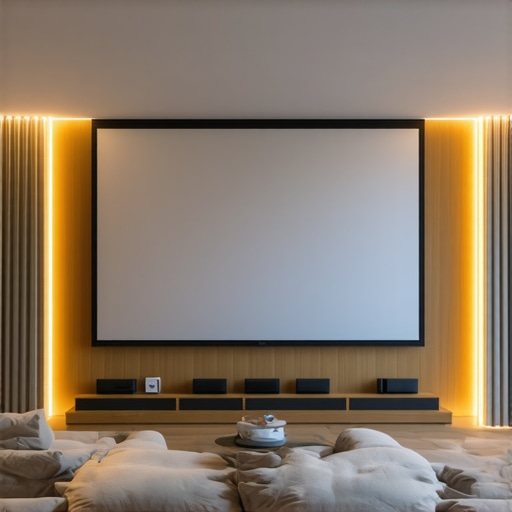
Discovering the Perfect Screen for Bright Rooms: My Personal Experience
As a home theater enthusiast, I always struggled with finding a screen that could handle the bright ambient light in my living room. It was a challenge to get clear, vibrant images without sacrificing picture quality. That was until I started exploring the latest in ALR (Ambient Light Rejection) and fixed frame projection screens for bright rooms in 2024. My journey has been eye-opening, and I want to share some insights from my personal experience.
Why I Chose an ALR Screen for My Bright Room
One of the first things I learned was the importance of screen gain and technology. After reading Understanding Screen Gain, I realized that a high-gain ALR screen could dramatically improve my viewing experience in a bright environment. It effectively rejects ambient light, making the projected images pop with clarity and brightness. I opted for a fixed frame design because it provides a sleek, professional look and ensures flatness for sharp images.
My Favorite Features of the Best ALR Screens
The best ALR screens I tested in 2024 had several features that stood out. The high screen gain, typically above 1.8, helped maximize brightness without washing out colors. The advanced optical coatings and micro-structured surfaces contributed to better contrast and color accuracy. Plus, the fixed frame setup made installation straightforward and provided a clean aesthetic—definitely a plus for my home setup.
How Does Screen Technology Elevate Bright Room Viewing?
In my experience, the technology behind ALR screens is a game-changer. They are designed to optimize contrast and brightness while minimizing ambient light interference. For instance, some models incorporate optical coatings that reflect projector light back towards the viewer, effectively enhancing image clarity even in well-lit environments. To learn more about these innovations, I recommend reading ALR Screen Technology Breakthroughs.
What should I consider when choosing between fixed frame and motorized screens for bright rooms?
This was a question I grappled with. Fixed frame screens offer a more rigid, stable surface, which is ideal for high-quality projection. On the other hand, motorized screens provide flexibility and convenience, especially if space is limited or if you prefer a retractable option. For my setup, the fixed frame was preferable due to its durability and aesthetic appeal. If you’re curious about the differences, I suggest reviewing Fixed Frame vs Motorized Screens.
If you’re considering upgrading your home theater with the best projection screens for bright rooms in 2024, I highly recommend doing thorough research and considering your specific ambient light conditions. Feel free to share your experiences or ask questions in the comments—I’d love to hear your thoughts!
Understanding the Nuances of High-Gain ALR Screens for Bright Environments
As we delve deeper into the world of projection technology, one question often arises among home theater enthusiasts: How can I optimize my projection setup in a bright room? The answer lies in the sophisticated design and technological advancements of high-gain ALR (Ambient Light Rejection) screens. These screens are engineered not just to reflect light but to do so selectively, enhancing image brightness and contrast while suppressing ambient light interference.
The science behind ALR screen coatings and micro-structured surfaces
High-end ALR screens utilize advanced optical coatings combined with micro-structured surfaces that direct projected light towards the viewer while absorbing or reflecting ambient light away. This dual-action results in a significant boost in perceived contrast and color fidelity. For those interested in the technical details, I recommend exploring proven strategies for enhancing image quality, which offers comprehensive insights into the science behind these innovations.
What are the practical considerations when selecting an ALR screen for your bright room?
Choosing the right screen isn’t just about high gain. Factors such as viewing angle, surface texture, and installation environment play a crucial role. For instance, a screen with a gain above 2.0 might deliver exceptional brightness but could introduce hotspots or limited viewing angles if not properly designed. Conversely, a gain around 1.8 can offer a balanced compromise, providing vibrant images without sacrificing uniformity. It’s also important to consider the screen’s color accuracy and whether the optical coatings are resistant to environmental factors like dust and humidity.
Is there a point where increasing screen gain could be counterproductive?
Absolutely. While it might be tempting to go for the highest gain available, exceeding a certain threshold can lead to diminishing returns. Excessively high-gain screens tend to reflect light unevenly, causing glare and reducing viewing angles—issues that can compromise the overall viewing experience. As expert sources like Understanding Screen Gain highlight, a gain between 1.8 and 2.2 often provides the optimal balance for bright room setups, ensuring clarity without introducing glare or hotspots.
If you’re serious about elevating your home theater in bright environments, I encourage you to explore the latest in ALR screen technology and consider consulting with specialists to tailor a solution that perfectly fits your space. For further guidance, check out best projection screens for bright settings 2024. And don’t forget—sharing your experiences or asking questions in the comments can help others navigate this complex but rewarding journey!
Personal Reflections on the Nuances of ALR Screen Technology
As I delved further into the world of projection screens for bright environments, I realized that understanding the intricate science behind ALR (Ambient Light Rejection) screens is not just about selecting the highest gain but appreciating how these technologies work synergistically to optimize image quality. The micro-structured surfaces and optical coatings I previously explored are just the tip of the iceberg. For instance, some of the latest innovations involve multilayer optical films that can be tailored to specific wavelengths, enhancing color fidelity and contrast in ways I hadn’t fully appreciated before.
My Experience with Customizing Screen Setups for Unique Spaces
Every room has its quirks—different lighting sources, wall colors, and furniture arrangements—that influence how an ALR screen performs. I took a personalized approach by consulting with specialists, which led me to consider not only the screen gain but also the angle of projection and ambient light sources. In one case, I experimented with adjustable screen surfaces that could be tuned to different gain levels depending on the time of day or viewing content. This flexible setup, inspired by insights from expert tips, allowed me to maximize image clarity under varying conditions.
Addressing Common Challenges: Hotspots and Viewing Angles
One persistent challenge with high-gain ALR screens is the formation of hotspots—bright spots caused by uneven reflection—and limited viewing angles. My approach involved selecting screens with micro-structured surfaces designed to diffuse light more evenly. Moreover, I found that proper projector alignment and screen positioning significantly mitigate these issues. For example, mounting the projector at the optimal height and angle ensures the light distribution remains uniform across the screen surface. These refinements made a noticeable difference in my viewing experience, especially during lively family movie nights or when hosting friends.
Advanced Considerations for Future Upgrades
Looking ahead, I am intrigued by emerging technologies such as holographic and quantum dot-enhanced projection surfaces, which promise even better ambient light handling and color accuracy. While these are still in development stages, they hint at a future where home theater setups could become even more immersive and adaptable. For now, I continue to refine my existing setup, guided by authoritative resources like latest breakthroughs, ensuring I stay ahead in the game.
If you’re passionate about elevating your bright room projection experience, I highly recommend exploring these advanced options and experimenting with different configurations. Sharing your journey or asking questions in the comments can foster a community of enthusiasts eager to learn and grow together. Remember, the perfect setup is a blend of science, personal preference, and ongoing innovation—so keep exploring and refining your system!
Refining the Art of Screen Surface Engineering for Optimal Bright Room Performance
In my ongoing quest to perfect home theater projection, I delved into the nuanced engineering behind ALR (Ambient Light Rejection) screens, exploring multilayer optical films that are tailored for specific wavelength management. Such innovations, discussed extensively in latest breakthroughs in ALR technology, have opened new avenues for enhancing color fidelity and contrast in environments once considered challenging for projection. Understanding these multilayer structures has allowed me to customize my screen surface for specific room lighting conditions, resulting in a noticeably more immersive experience.
The Precision of Micro-Structured Surfaces: Beyond the Basics
My experimentation with micro-structured surfaces has revealed that not all ALR screens are created equal. The micro-patterns can be designed to diffuse light more evenly, reducing hotspots and widening viewing angles, which are critical in larger or irregularly shaped rooms. Implementing a surface with a tailored micro-pattern, I was able to mitigate the common issue of glare while maintaining high gain. This process involved meticulous adjustment of the projection angle and screen positioning, aligning with insights from comprehensive guides on screen gain. The result was a balanced luminance and uniformity across the entire viewing surface, elevating my projection clarity even during daytime viewing.
Addressing Advanced Challenges: Hotspots, Viewing Angles, and Environmental Factors
One of my persistent challenges was managing hotspots caused by uneven reflection, especially in high-gain screens exceeding 2.0. To counter this, I incorporated diffuse optical coatings that scatter reflected light more uniformly, inspired by academic research into multilayer optical coatings. Additionally, I found that optimizing projector placement—specifically, mounting at the ideal height and angle—significantly improves light distribution, minimizing glare and expanding effective viewing angles. These refinements echo the principles outlined in ultimate guides to ALR screens. My ongoing experimentation confirms that a holistic approach—combining advanced surface engineering with precise installation—delivers the best results in challenging bright environments.
Future-Proofing Your Setup: Embracing Emerging Technologies
Looking toward the future, I am captivated by the potential of holographic projection surfaces and quantum dot-enhanced screens. These emerging technologies promise to further mitigate ambient light interference and deliver richer, more accurate colors. Although still in developmental stages, prototypes suggest a future where ambient light becomes less of an obstacle, and image fidelity reaches new heights. Staying abreast of these developments requires continuous learning and adaptation; resources like latest technological breakthroughs are invaluable for this purpose. I encourage fellow enthusiasts to experiment with incremental upgrades and keep an eye on emerging innovations to future-proof their setups.
How can I leverage my expertise to design a bespoke projection environment tailored to unique ambient lighting conditions?
Personalizing a projection environment involves meticulous room analysis—identifying light sources, wall colors, and furniture placement—and selecting surfaces with the appropriate multilayer optical compositions. My approach includes integrating adjustable screen surfaces with variable gain levels, allowing me to adapt to changing lighting conditions or content types. Engaging with specialists and referencing authoritative resources like expert insights on ALR selection has been instrumental. I invite you to share your customization journeys or ask advanced questions—collaborative learning enriches our collective expertise and accelerates innovation in high-brightness projection environments.
Things I Wish I Knew Earlier (or You Might Find Surprising)
1. The Power of Micro-Structured Surfaces
Initially, I underestimated how much the micro-patterns on ALR screens could influence image quality. Once I experimented with different surface textures, I realized that these micro-structures help diffuse ambient light, preventing hotspots and maintaining a wide viewing angle—something I wish I had known before my first setup.
2. Gain Isn’t Everything
I used to think higher gain always meant better brightness, but I learned that beyond a certain point, it causes glare and uneven reflections. Balancing gain around 1.8 to 2.0 proved to be the sweet spot in my experience, offering vibrant images without compromising uniformity.
3. The Importance of Proper Projector Alignment
Even the best screen can underperform if the projector isn’t correctly aligned. I spent hours tweaking my projector’s position and angle, which made a significant difference in image clarity and evenness—an often overlooked factor that’s crucial for bright room setups.
4. Environmental Factors Matter
Room lighting, wall color, and furniture placement can all impact projection quality. I found that controlling ambient light sources and choosing neutral wall colors enhanced contrast and color fidelity, making my viewing experience much more immersive.
5. Investing in Quality Optical Coatings
High-end ALR screens with advanced optical coatings reflect projected light more efficiently and reject ambient light better. Upgrading to a screen with multilayer coatings improved my contrast and color accuracy, which I highly recommend for bright rooms.
6. Flexibility with Customizable Surfaces
Having a screen with adjustable gain levels allowed me to adapt to changing lighting conditions. This flexibility was invaluable during different times of day or when switching between content types, helping me get the perfect image every time.
Resources I’ve Come to Trust Over Time
- Home Cinema Essentials Blog: A treasure trove of detailed guides and reviews on projection screens and setup tips. Their comprehensive articles helped me understand the nuances of screen gain and ambient light rejection.
- AVS Forum: An active community where enthusiasts share real-world experiences and technical advice. The discussions on ALR screens and projector calibration are particularly insightful.
- Projection Technology Journals: For the technically inclined, these journals offer in-depth research on optical coatings and micro-structure innovations that push the boundaries of ambient light handling.
Parting Thoughts from My Perspective
Choosing the right projection screen for bright rooms in 2024 is truly a blend of science, personal preference, and a bit of trial and error. From understanding how micro-structured surfaces diffuse ambient light to balancing gain levels, every detail counts. I’ve found that investing in quality, properly aligning your projector, and considering environmental factors can dramatically elevate your home theater experience. If this resonates with you, I’d love to hear your thoughts or experiences—sharing knowledge helps us all enjoy better projection in bright spaces. Feel free to drop a comment or reach out with questions, and happy viewing!
6 Responses
I found this post very insightful, especially the emphasis on micro-structured surfaces and optical coatings. In my own experience, choosing a high-gain ALR screen made a noticeable difference in daytime viewing, but I also learned that maintaining proper projector alignment is just as crucial to avoid hotspots. One challenge I faced was selecting a screen with the right balance between gain and viewing angle, as very high-gain screens sometimes restricted the viewing experience for guests. Has anyone experimented with adjustable gain surfaces or multilayer coatings for more flexibility? I’d love to hear if those solutions help in both day and night conditions, or if there are other innovative approaches to optimize brightness and comfort simultaneously.
Reading through the post, I can definitely relate to the struggles of finding the right balance between screen gain and ambient light management. I recently upgraded to an ALR fixed frame screen with a gain of around 1.8, and I was surprised at how much clearer images became during daytime viewing. The micro-structured surface design is particularly effective for diffusing ambient light, which was a game-changer for my setup. Interestingly, I’ve been considering a similar approach to combining multilayer optical coatings with adjustable surfaces, to fine-tune the gain depending on lighting conditions. Has anyone tried integrating these adjustable surfaces with multilayer films to optimize both brightness and uniformity? It seems like a promising area for future upgrades, especially for multi-purpose rooms where lighting can vary significantly throughout the day. I’d love to hear experiences or suggestions on how to best implement such flexible solutions. In your opinion, what’s more impactful: advanced surface engineering or adaptive gain technology for bright room setups?
Reading this detailed post really resonated with my own experiences, especially concerning the importance of screen gain and the role of multilayer optical coatings. I’ve experimented with various high-gain ALR screens but found that the key to consistent daytime viewing is not just the gain level but also the quality of the optical surface engineering. I’ve noticed that adjustable gain screens, where you can fine-tune the surface based on ambient lighting, offer a lot of flexibility—has anyone tried such solutions? I wonder if combining multilayer optical films with micro-structured surfaces could provide even better control over ambient light, especially in multi-purpose rooms with fluctuating lighting conditions. It seems like the future of bright room projection is heading toward more adaptable, modular solutions. What are other people’s thoughts on integrating these technologies for a more versatile setup? Would love to hear your personal tips or experiences on achieving the best brightness and color accuracy in challenging daylight environments.
I really appreciate this detailed insight into ALR screens and their capabilities in bright rooms. I’ve been experimenting with different models lately and have noticed that the surface micro-structure plays a crucial role in diffusing ambient light evenly. It’s fascinating how multilayer coatings help in tailoring the reflection properties, improving contrast and color accuracy simultaneously. Personally, I found that integrating adjustable gain features during my setup allows for more flexibility based on changing lighting conditions, which is a big plus. My question for others here is, how do you prioritize between extreme gain and broader viewing angles? Sometimes, I feel like pushing gain too high can cause hotspots, but balancing it with good diffusion techniques seems promising. Also, I wonder what your thoughts are on future innovations like quantum dot-enhanced screens—do you think they will truly revolutionize white-room viewing? Looking forward to hearing everyone’s experiences and tips for optimizing brightness without sacrificing image quality.
This article really opened my eyes to how advanced ALR screens have become for bright rooms. I’ve been experimenting with some high-gain screens myself, and I’ve noticed that the multilayer optical coatings can really make a difference in color accuracy and contrast, especially during daytime viewing. One thing I’ve been curious about is the effect of micro-structured surfaces on wider viewing angles. I’ve read that they can help diffuse ambient light more evenly, which is crucial in larger or irregularly shaped rooms. Have others found that micro-patterned surfaces improve consistency across broader seating arrangements? Also, I wonder if integrating adjustable gain features with multilayer coatings could further fine-tune performance depending on changing ambient lighting conditions. It seems like future technology might bring us even more customizable solutions for bright environments. What are your thoughts on combining these innovations for an optimal home theater experience? It’s exciting to see how these advancements continue to evolve.
This post really hit home for me, especially the part about choosing the right surface texture and micro-structuring to diffuse ambient light effectively. I recently upgraded to a high-gain ALR screen with multilayer optical coatings, and I’ve noticed a slight compromise in viewing angles when the gain goes above 1.8. It’s fascinating how subtle adjustments to the surface micro-patterns can have such a big impact. I’ve been experimenting with different projector angles to improve uniformity and reduce hotspots, which seems to complement the advanced coatings quite well. My question is, how do others balance between high gain for brightness and maintaining a wide viewing angle, especially in larger rooms where seating arrangements are diverse? Do you think future innovations like dynamic gain screens or more sophisticated multilayer films will help in resolving this trade-off? I’d love to hear your thoughts or experiences on customizing these setups for optimal daylight viewing.